Recently I was in a conversation with someone when I was criticized for saying a true statement that others felt was offensive. It was not a statement directed at anyone in particular, I was only pointing out a widely recognized public opinion statement. But, because that statement (though factual) was not preferred by the people with whom I was speaking, I was told that I was being hateful.
The truth can hurt. The truth can be spoken in wrong ways or at wrong times, but I am convinced it is never hateful to tell the truth, and unless you are hiding someone from a serial killer it is not wrong to tell the truth.
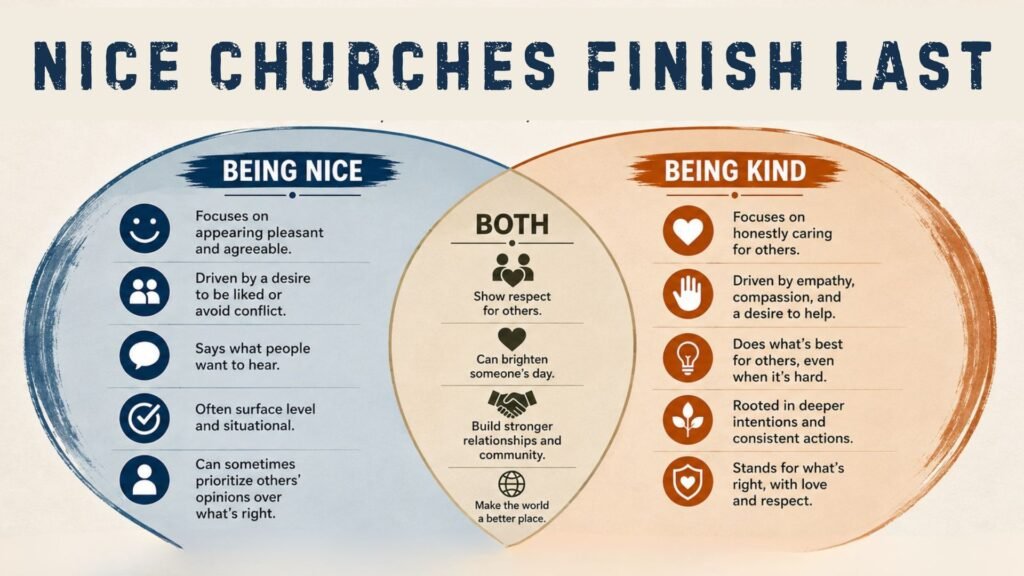
Much of polite society disagrees. We live in a world that prioritizes being nice above nearly all else—for instance I was once told that sin is not doing wrong things, it is hurting someone else’s feelings. I asked Chat GPT to create a Venn diagram that compares nice and kind to help me understand them better. I learned that being nice seems pretty good on the surface.
However, the Bible does not prioritize niceness. In fact, the word nice does not even appear in the Bible. Instead, the Bible demands that we be kind, and there is a significant difference.
All of these things together led me to consider the church. The truth: nice churches finish last. Just think about it, a nice church is the kind of church that tells people what they want to hear (Paul warns about people searching for teachers who will “suit their own passions in 2 Timothy 4:3). A nice church always says yes. A nice church is mostly concerned with not upsetting anyone. That kind of church may be nice, but it can never be biblical and it can never be true.
A Christ-honoring church should be kind. But kind does not mean avoiding the truth. A kind church is one that speaks the truth, even when the truth is hard to hear—especially when the truth is required to bring about repentance. A biblical church does not desire conflict, but it is willing to contend for the faith (Jude 1:3) and to deal with conflict when necessary to fulfill that purpose. Nice churches have a tendency to stand for nothing and to welcome all opinions, but those churches are on the way to not being churches at all, only social clubs.
As a pastor, I really like being nice, in fact I want to be nice all the time. One of the greatest struggles in my life is is that my desire to be nice can come at the expense of being kind. I don’t like to make people mad or sad. I do not enjoy confronting sin and misunderstanding. My desire to be nice is often not rooted in my desire to do what is best for others, but to do what is best or easiest for me. Telling someone they have cancer is not nice, but if a doctor chooses to be nice so that she doesn’t make her patients sad, that doctor has ceased to be kind. In an effort to be nice, the doctor has given a death sentence.
The same is true for churches. If you are going to be a healthy, biblical church, you must prioritize godliness, biblical fidelity, and yes, kindness; but you must do away with the desire to be nice at all costs. Being nice is often sinful because it will tempt you to avoid the truth and will tempt you to choose to make others happy rather than to honor God. Remember, you can tell the truth and still be considerate of others. You can say no, and still be a good person. But you can not always satisfy the desires of a world that prioritizes niceness and glorify God.
Nice churches don’t finish last because mean churches thrive. Churches should never be mean-spirited. The Fruit of the Spirit is love, joy, peace, patience, kindness, goodness, faithfulness, gentleness, self-control. There is no room for meanness (as my momma would say) or for churches to prioritize a quarrelsome attitude. But, being nice is not a fruit of the Spirit and it may very well be just the opposite.
So, I encourage you, find a biblical church that is governed by the Bible and glorifies God. Understand, however, that a healthy, Bible-believing church may not always be nice, because the Bible is not always nice. The Bible demands that we change, we repent, we be transformed, and that we look more like Jesus and less like the damaged and sinful versions of ourselves that we become in our sin.