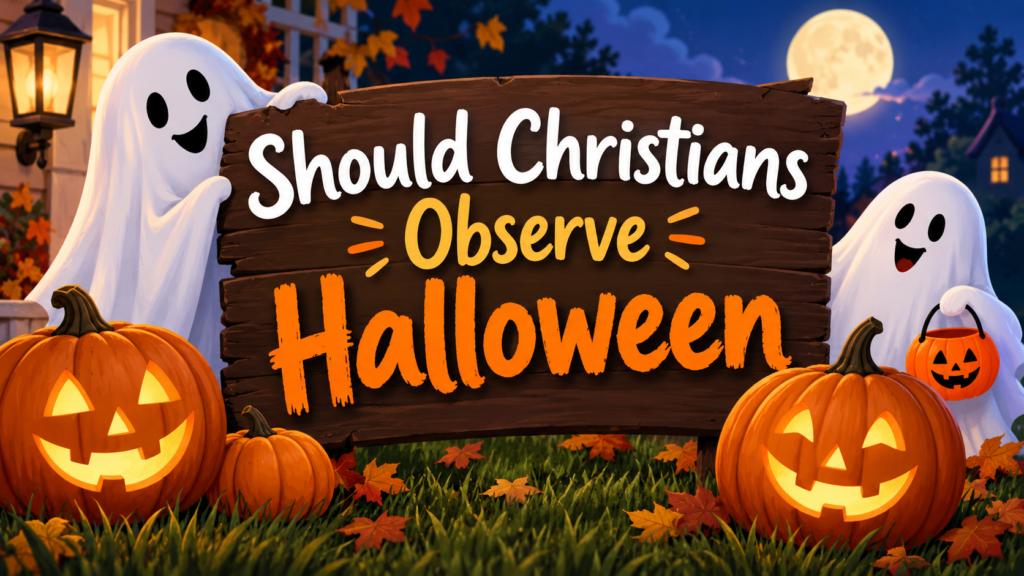
Every year our church sponsors a trunk or treat on or around October 31st. Normally we have a few people inside and outside of our church question us on our decision to host an event like this. Often they feel our position should be to register a protest against Halloween rather than observing it on our church property. Some are concerned with the potential pagan roots of Halloween and others with concern that by hosting this event on Halloween night we implicitly or explicitly condone our culture’s perverted appreciation for a holiday that many have devoted to things dark and evil.
Space does not permit me to deal with all of the Christian and pseudo-Christian responses to Halloween, nor do I feel that all are worthy of a response, but I would like to share some of my personal convictions and the convictions of many at Malvern Hill Baptist Church that lead us to engage our community each year on Halloween with a trunk or treat that draws in several hundred unchurched citizens of our community.
- Pagan history does not prohibit Christian activity. When Paul met with the philosophers at the Areopagus in Acts 17:22-34 he engaged them on their own pagan terms. This was the site of much pagan religion and speculation, but Paul saw the opportunity to redeem the pagan and substitute their false gods with the One True God. Because our culture sees Halloween as a celebration of the dark and macabre does not mean that we must retreat from our opportunity to redeem the culture. Even if Halloween has pagan roots, Christians are not required to allow pagan roots to hold forever.
- We are not seeking to provide a safe alternative to Halloween. First, I’m not convinced that Halloween night is necessarily dangerous. As Christians, we reject superstitions that lead to beliefs that the spirit world is more active on Halloween than on November 1st. In fact, what I understand of spiritual warfare suggests to me that we should be more concerned about spiritual attack when it is least expected. Additionally, research and crime statistics suggest that our world is safer from violent crime today than it was thirty years ago. I’m not convinced that we need a “safe” alternative. What we need is a missional alternative. We need to be on the offensive against the darkness of our culture carrying the light of Christ to those lost in the darkness of sin.
- It is the responsibility of the church to reach lost sinners. We can host a Halloween event without endorsing many of the things about Halloween that cause Christian concern in the same way that Jesus could interact with sinners without engaging in sin (Matt. 9:9-13, 11:18-19, etc.). It is a rare occasion when non-Christian people will freely walk onto the grounds of our church property and rub shoulders with members of Malvern Hill who will love them in the name of Jesus. On Halloween (or whichever night we host our trunk or treat), people show up by the droves and are greeted with smiles, candy, and a good time. In addition, they are given opportunities to hear the gospel presented in a myriad of ways (multi-media presentations, one-on-one evangelistic encounters, gospel tracts, and relationship evangelism).
- We believe evangelism is multi-faceted and usually requires more than one encounter. Historically, more than 60% of the people who have attended Halloween themed events at Malvern Hill are unchurched. Most of these people will not be converted during one candy-filled event on our church property, these sorts of events not only give us opportunities for evangelism, but for building relationships. Many people visit our church after attending events like our trunk or treat. It is our prayer that relationships and follow-up will lead to more opportunities to communicate the gospel and will result in greater gospel harvests.
- We have a responsibility to provide missional opportunities for our church members. If the church is to be missional, the people need to be given opportunities and need to be encouraged to engage in missions. Our adults and teenagers need to engage in mission by volunteering, praying, and sharing their faith. Our children can participate in this missional outreach by inviting their friends at school. This event involves the entire church and gives unique opportunities for people at any age-group to be integrally involved. Missions is more than event-evangelism, but part of helping people in the church learn how to share their faith in the everyday things of life is by providing opportunities within the context of church-life to help believers share their faith.
- We are called to be salt and light in our community. Is your community better because of the presence of your church? Our trunk or treat presents an opportunity for us to love on the changing community surrounding our church building. In our changing community, many residents have no interest in our predominantly white, predominantly middle-class church. Our fall festival is one of the ways we are working to earn and maintain the trust of our community so that we can be more effective in our evangelism.
- Christians should be especially mindful about their witness on Halloween. There is no place for Christians to do on Halloween that which would be deemed inappropriate on any other day. Costumes and decorations should represent Christ well, even (especially?) on Halloween. For instance, Christians should not dress up as the devil, in sexually suggestive costumes, or in anything that would tarnish the name of Christ.
- Be mindful of the weaker brother. In Romans 14 and1 Corinthians 8, Paul gives attention to those who are weaker in their faith and reminds believers to me mindful of causing others to stumble. Rather than dig into all of the potential ways that Halloween could be a struggle for your weaker brothers and sisters, I would just encourage you to consider them and consider how your observance of this holiday should build up other Christians rather than damage their faith.
With these things in mind, I close by saying that I do not like Halloween. I’ve never liked it, I find it to be a ridiculous holiday that serves as a money-making speed bump on the way to holidays that matter like Thanksgiving and Christmas. I celebrate the Reformation during October and, in protest to Halloween, I begin playing Christmas music long before most of you would deem it appropriate. However, I believe it is my Christian responsibility to participate in Halloween. Perhaps blogger Tim Challies is right and people’s participation in Halloween represents their longing for community. Maybe their participation is darker and it represents their affinity for the occult, or perhaps they want attention, or maybe there are no good reasons and people are just following the crowd without thinking (which seems a lot like they have no real purpose in life and simply follow the path of least resistance). Regardless of why it is that people participate in Halloween, I suspect that many of those who are most strongly committed to Halloween need the presence of Christ and of His children.
So, I don’t like Halloween. There are many other things that I don’t like, but that I need to participate in for the sake of the gospel, and I believe that Halloween is one of them. We will continue to host a trunk or treat because it provides a safe and fun alternative to turning my lights off and hiding from the world and opens up an opportunity to instead let our light shine before all men and women here in East Camden. Wyatt (my son) asked me once when he was young what Halloween was all about, “Does it have to do with Jesus?” I responded this way, “No, son, but we can use the events of Halloween to tell others about Jesus.” Halloween gives us to the opportunity to practice Christian hospitality on a day when even non-Christians are being overly hospitable. Are you witnessing more strongly to the love of Christ in a dark home retreating from the world, or by showing Christ’s love to a world longing for a sense of purpose and belonging?